
Relationships and family systems are an important part of daily life. When those relationships become strained, communication breaks down, or patterns of conflict develop, it can affect emotional well-being, decision-making, and overall stability.
Couples and family counseling provide a structured, professional setting to address these concerns. Rather than focusing only on individual symptoms, this type of counseling looks at how people interact, communicate, and function together.
Many individuals and families are unsure when counseling is appropriate or whether their situation “warrants” professional support. This article outlines common indicators, what counseling involves, and what to expect if you decide to move forward.
Understanding Couples and Family Counseling
Couples and family counseling are forms of therapy designed to address relationship dynamics. This includes communication patterns, conflict resolution, roles within the family, and how individuals influence one another over time.
The focus is not on assigning blame. Instead, counseling helps identify patterns, clarify concerns, and introduce structured ways to improve interaction.
Depending on the situation, counseling may involve:
- Couples attending sessions together
- Parents and children participating jointly
- Individual sessions as part of a broader family plan
The approach is guided by clinical training and evidence-based practices, with an emphasis on clarity, consistency, and measurable progress.
Common Reasons People Seek Couples Counseling
Many couples wait until challenges feel overwhelming before considering counseling. In practice, counseling is often most effective when concerns are addressed early, before patterns become more difficult to change.
Some of the most common reasons couples seek counseling include:
Ongoing Communication Difficulties
Conversations may frequently lead to misunderstanding, defensiveness, or withdrawal. Over time, communication may become limited or avoidant, making it difficult to address even routine issues.
Counseling helps establish clearer communication structures, allowing each person to express concerns in a way that can be understood and addressed.
Repeated Conflict Without Resolution
Disagreements are a normal part of any relationship. However, when the same conflicts repeat without resolution, frustration can increase and trust may decline.
Counseling focuses on identifying the underlying patterns that contribute to repeated conflict and developing more effective ways to navigate disagreements.
Changes in the Relationship
Life events such as career changes, parenting transitions, relocation, or health concerns can place strain on a relationship. Even positive changes can create stress if expectations and roles are not clearly defined.
Counseling provides a structured setting to adjust to these changes and maintain stability.
Decreased Connection or Engagement
Some couples report feeling disconnected, even without significant conflict. This may include reduced communication, limited shared activities, or a general sense of distance.
Counseling can help clarify contributing factors and support the development of more consistent engagement.
Common Reasons Families Seek Counseling
Family counseling often involves multiple individuals with different perspectives, expectations, and concerns. The goal is to improve how the family functions as a system rather than focusing on one individual alone.
Common reasons families seek counseling include:
Parent–Child Conflict
Differences in expectations, discipline approaches, or communication styles can lead to ongoing tension between parents and children.
Counseling helps establish clearer boundaries, expectations, and communication strategies that are consistent across the household.
Behavioral or Emotional Concerns
When one family member is experiencing behavioral or emotional challenges, it often affects the entire family system.
Family counseling provides a coordinated approach that supports both the individual and the broader family environment.
Blended Family Adjustments
Families adjusting to new structures—such as remarriage or combining households—may experience challenges related to roles, boundaries, and expectations.
Counseling offers a structured way to address these transitions and promote stability.
Major Life Changes or Stressors
Events such as divorce, loss, relocation, or changes in family structure can disrupt established routines.
Counseling helps families adapt to these changes while maintaining clear communication and support.
When Is the Right Time to Start Counseling?
A common question is whether a situation is “serious enough” to begin counseling. In many cases, waiting until problems escalate can make resolution more complex.
It may be appropriate to consider counseling when:
- Concerns are persistent rather than temporary
- Communication feels unproductive or strained
- Conflict is frequent or unresolved
- There is uncertainty about how to move forward
- Stress within the relationship is affecting daily functioning
Counseling is not limited to crisis situations. It can also be used proactively to strengthen communication and prevent further strain.
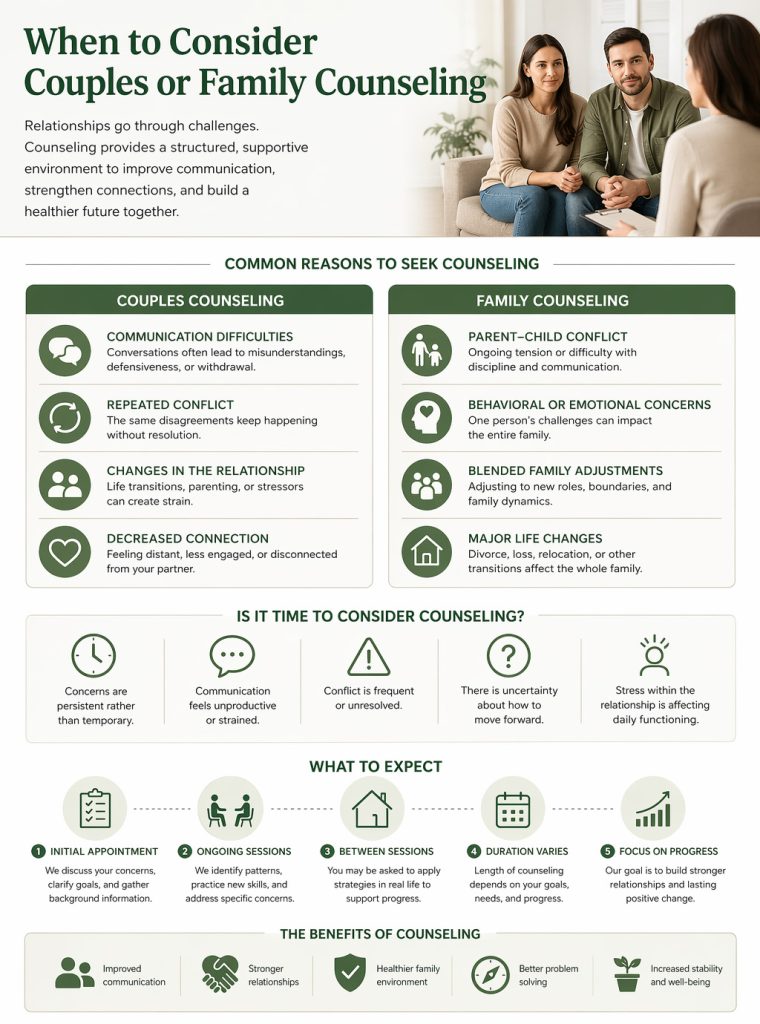
What to Expect in Couples or Family Counseling
Understanding the process can reduce uncertainty and help individuals feel more prepared to begin.
Initial Appointment
The first session typically focuses on:
- Understanding the concerns that led to counseling
- Clarifying goals for treatment
- Gathering relevant background information
This provides a foundation for developing a structured plan.
Ongoing Sessions
Subsequent sessions may include:
- Identifying patterns in communication or behavior
- Practicing new ways of interacting
- Addressing specific concerns or situations
Sessions are structured and guided, with a focus on maintaining clarity and progress over time.
Between-Session Expectations
In some cases, individuals or families may be asked to apply strategies discussed in session. This helps reinforce progress and supports real-world application.
Duration of Counseling
The length of counseling varies depending on:
- The complexity of the concerns
- The goals identified at the outset
- The level of consistency in attendance and participation
Some individuals seek short-term support for specific concerns, while others engage in longer-term counseling.
Addressing Common Concerns About Counseling
It is common to have questions or reservations before starting counseling. Addressing these directly can make the process more approachable.
“Will the therapist take sides?”
In couples and family counseling, the role of the clinician is to remain neutral and focused on the overall functioning of the relationship or family system.
The goal is not to determine who is right or wrong, but to improve communication, understanding, and outcomes.
“What if one person is unsure about attending?”
It is not uncommon for one individual to feel uncertain about counseling. Initial sessions often focus on clarifying concerns and expectations so that all participants understand the purpose and process.
“What if we’ve tried to resolve this on our own?”
Many couples and families attempt to address concerns independently before seeking professional support. Counseling introduces structure, perspective, and strategies that may not be available without clinical guidance.
The Value of a Structured Approach
One of the key benefits of couples and family counseling is the structured environment it provides. Conversations that may feel unproductive in everyday settings are guided in a way that supports clarity and resolution.
This includes:
- Defined goals
- Consistent session structure
- Professional facilitation
- Evidence-based methods
This structure helps reduce confusion and keeps the process focused.
Counseling as Ongoing Support
Counseling does not need to be limited to periods of significant stress. Some individuals and families use counseling as part of ongoing support to maintain stability, improve communication, and address concerns as they arise.
This approach can help prevent issues from becoming more complex over time.
Taking the Next Step
If you are considering couples or family counseling, the first step is a straightforward conversation about your situation and what you are looking for.
At Counseling Affiliates of Nebraska, services are designed to provide:
- Clear expectations
- Structured sessions
- Professional, evidence-based care
Whether you are addressing ongoing concerns or seeking guidance during a transition, counseling can provide a consistent and reliable framework for moving forward.
To begin, you can request an appointment and receive clear information about next steps and availability.