
When many people think about counseling, they picture a time of significant distress: a relationship has reached a breaking point, anxiety feels unmanageable, a family conflict has escalated, or a difficult life event has become too much to handle alone. Counseling can be very helpful during those moments. It can provide structure, support, and professional guidance when life feels especially difficult.
But counseling is not only for crisis.
For many individuals, couples, and families, counseling can also be a steady form of ongoing care. It can support people as they manage stress, communicate more clearly, adjust to transitions, maintain progress, or better understand patterns that affect daily life. In this way, counseling is not just a response to an urgent problem. It can also be part of a thoughtful approach to emotional, relational, and behavioral health.
At Counseling Affiliates of Nebraska, we work with individuals, couples, and families in Lincoln, Omaha, and across Nebraska who are seeking structured, professional support. Some begin counseling during a difficult season. Others come because they want to address concerns before they become more disruptive. Both reasons are valid.
Understanding counseling as ongoing care can help reduce uncertainty and make it easier to know when reaching out may be appropriate.
Counseling Can Support More Than Immediate Problems
It is understandable that people often wait until a concern feels serious before contacting a counselor. Many individuals try to manage things on their own for a long time. They may tell themselves that their stress is normal, that a relationship issue will settle down, or that they should be able to handle a difficult season without outside support.
In some situations, problems do improve with time, rest, or practical changes. In other situations, concerns continue to build. Stress affects sleep. Communication becomes more strained. A person may feel less patient, less focused, or less connected to others. Families may fall into patterns that are hard to change without help.
Counseling offers a structured setting to examine those concerns before they become more difficult to manage. It does not require a person to be in crisis. A counselor can help clients identify patterns, clarify goals, and consider practical next steps in a professional and supportive environment.
This can be especially helpful for people who feel that something is “off,” but are not sure how to describe it. Counseling can provide space to slow down, organize concerns, and better understand what may be contributing to stress or conflict.
Ongoing Care Helps Create Structure
One of the most important parts of counseling is structure. Many people already think about their concerns throughout the week, but thinking alone is not always the same as working through an issue. Without structure, it can be easy to repeat the same worries, arguments, or decisions without gaining clarity.
Counseling provides a defined time and place to focus on what is happening. Sessions may include discussion of current stressors, past patterns, relationship dynamics, coping strategies, communication concerns, or goals for change. The process is professional and collaborative, with attention to the client’s needs and circumstances.
This structure can be useful even when life is not in crisis. For example, a person may use counseling to better manage work stress, improve boundaries, navigate family responsibilities, or understand emotional reactions. A couple may seek counseling to strengthen communication before problems become more entrenched. A family may use counseling to address changes in routine, parenting challenges, or conflict that has become repetitive.
Ongoing counseling does not mean someone is failing to cope. It often means they are taking a thoughtful, proactive approach to their well-being and relationships.
Counseling Can Help During Transitions
Life transitions are one of the most common reasons people consider counseling. Some transitions are planned, such as marriage, divorce, a career change, relocation, becoming a parent, or adjusting to an empty nest. Others are unexpected, such as job loss, illness, grief, legal involvement, or sudden changes within a family.
Even positive transitions can create stress. A new opportunity may still involve uncertainty. A family change may bring both relief and difficulty. A personal milestone may raise questions about identity, priorities, or relationships.
Counseling can help clients make sense of these changes. It can provide a setting to talk through decisions, understand emotional responses, and develop practical ways to move forward. For families and couples, counseling can also help improve communication during periods when expectations and responsibilities are changing.
In Lincoln and Omaha, many individuals and families seek counseling during these kinds of adjustment periods. They may not describe themselves as being in crisis, but they recognize that support could help them navigate the transition with more clarity and stability.
Counseling Can Support Long-Term Emotional Health
Emotional health is not static. Stress levels, relationships, responsibilities, and personal needs change over time. For that reason, counseling can be useful at different stages of life.
Some clients attend counseling for a defined concern and then return later when circumstances change. Others continue for a longer period because regular support helps them maintain focus, accountability, and self-awareness. The appropriate length and frequency of counseling depends on the person, the goals, and the nature of the concerns being addressed.
Ongoing care may involve learning to recognize early signs of stress, improving coping strategies, strengthening communication, or becoming more aware of patterns that affect decision-making. Counseling may also support people managing anxiety, mood concerns, trauma-related symptoms, substance use issues, family conflict, or other behavioral health concerns.
It is important to note that counseling is not about promising a specific outcome. Instead, it is a professional process designed to help clients better understand their concerns, identify goals, and work toward healthier patterns with appropriate guidance.
Counseling Is Not a Sign That Something Is “Wrong”
A common misconception is that counseling is only for people who are at a breaking point. This belief can make it harder for people to reach out. They may worry that their concerns are not serious enough, or they may feel uncomfortable asking for help when they are still functioning in daily life.
In reality, many people who seek counseling are managing responsibilities, caring for families, working, attending school, or meeting daily expectations. They may simply recognize that certain areas of life need attention.
Counseling can be appropriate when stress is becoming more difficult to manage, when communication feels strained, when emotions feel harder to regulate, or when a person wants a more objective place to sort through concerns. It can also be helpful when someone wants to better understand patterns that continue to show up in relationships, work, parenting, or personal decision-making.
Seeking counseling does not mean a person is weak or incapable. It means they are choosing a structured, professional setting to address concerns with care and intention.
Counseling Can Help Couples Before Conflict Escalates
Couples often wait until communication has become highly strained before seeking counseling. While counseling can help during serious relationship distress, it can also be valuable earlier.
Couples counseling may help partners discuss recurring disagreements, clarify expectations, improve communication, or better understand how each person responds to stress. The goal is not to assign blame. The goal is to create a more structured and respectful process for addressing concerns.
Some couples seek counseling when they notice distance, tension, or repeated misunderstandings. Others attend during major life changes, such as parenting transitions, financial stress, blended family adjustments, or changes in work responsibilities.
When couples view counseling only as a last resort, they may miss opportunities to address concerns before resentment builds. Ongoing or early support can help couples identify patterns and develop more effective ways to communicate.
Counseling Can Support Families Through Change
Families experience stress in many forms. Parenting challenges, school transitions, divorce, grief, behavioral concerns, sibling conflict, and changes in household structure can all affect family functioning.
Family counseling can provide a structured setting where concerns are discussed with professional guidance. Depending on the situation, counseling may focus on communication, expectations, routines, boundaries, emotional responses, or specific areas of conflict.
As with individual or couples counseling, family counseling does not have to wait until a crisis occurs. Sometimes families seek support because they notice patterns that are becoming harder to manage. A child or adolescent may be struggling with adjustment. Parents may feel unsure how to respond consistently. Family members may be communicating in ways that increase tension rather than reduce it.
Counseling can help families slow down, clarify concerns, and work toward more constructive interactions.
Counseling Can Reduce Confusion About Next Steps
One reason people delay counseling is uncertainty. They may not know what type of service they need, what happens during an appointment, whether their concerns are appropriate for counseling, or how to begin.
A clear counseling process can reduce that uncertainty. At Counseling Affiliates of Nebraska, the first step is a conversation about the client’s needs and the appropriate next steps. This may include discussing the reason for seeking services, identifying whether counseling or another service is appropriate, and explaining what to expect.
For some clients, counseling is the right fit. For others, a psychological evaluation, forensic evaluation, or referral to another provider may be more appropriate. Clarity at the beginning helps ensure that clients are directed toward the right type of support.
This is especially important because Counseling Affiliates of Nebraska provides both counseling services and psychological or forensic evaluation services. These services serve different purposes and follow different processes. Counseling is treatment-focused and supportive. Evaluations are assessment-focused and may be used for clinical, legal, court, or agency-related purposes.
When clients understand the difference, they can make more informed decisions about what they need.
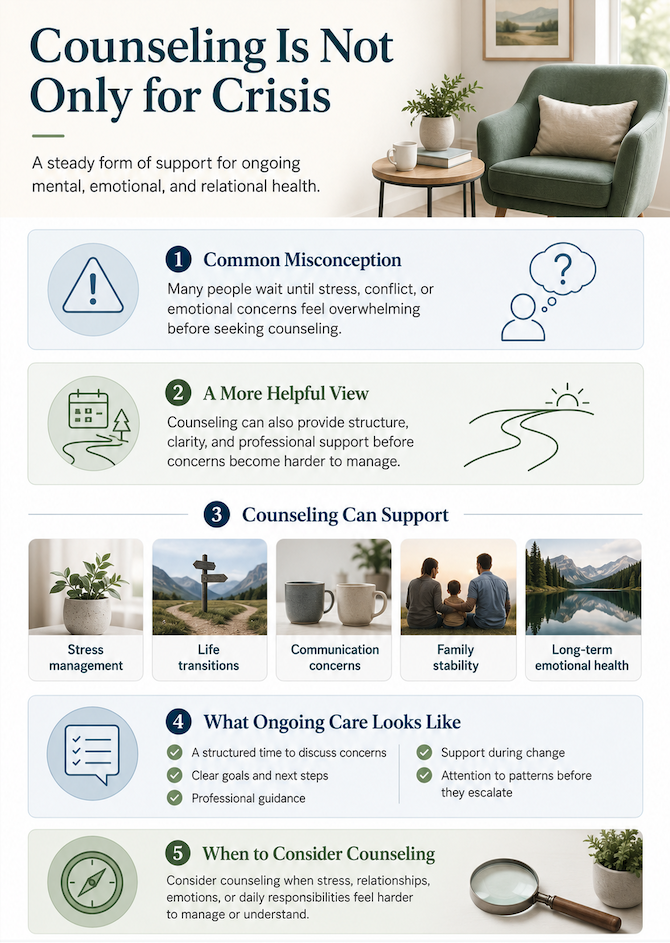
A steady form of support for ongoing mental, emotional, and relational health.
Ongoing Care Can Be Preventive
Preventive care is a familiar concept in many areas of health. People schedule regular medical checkups, attend dental cleanings, maintain exercise routines, or make changes to reduce future health risks. Mental and relational health can also benefit from ongoing attention.
This does not mean every person needs counseling at all times. It means counseling can be considered before a problem becomes overwhelming. When someone notices increased stress, repeated conflict, difficulty adjusting, or changes in mood or behavior, counseling may provide an opportunity to address those concerns earlier.
Preventive counseling may help clients build awareness, strengthen coping skills, and make practical changes. It may also help identify when additional support or evaluation is needed.
For individuals, couples, and families in Lincoln and Omaha, this approach can make counseling feel less like a last step and more like a professional resource available when life requires additional structure and guidance.
Counseling Can Be Part of Responsible Support
Many people carry significant responsibilities. They may be managing work, family obligations, caregiving, legal stress, school concerns, health issues, or relationship strain. Over time, these responsibilities can affect emotional health and decision-making.
Counseling can provide a place to examine how these pressures are being managed. It can help clients consider what is within their control, what support may be needed, and what patterns may be contributing to ongoing stress.
This kind of support is not about creating dependence on counseling. It is about using professional guidance appropriately. For some clients, a short period of counseling may be sufficient. For others, longer-term support may be helpful. The process should be based on the client’s needs, goals, and progress.
A responsible counseling relationship includes clear expectations, professional boundaries, confidentiality, and attention to the client’s overall well-being.
What to Expect When Starting Counseling
Starting counseling can feel unfamiliar, especially for someone who has not attended before. Knowing what to expect can make the process easier.
The first step is typically an inquiry or appointment request. From there, the office may gather basic information, discuss the type of service requested, and determine whether the practice is an appropriate fit. Clients may be asked about their concerns, availability, insurance or payment questions, and whether they are seeking counseling or an evaluation.
During an initial counseling appointment, the clinician may ask about current concerns, relevant history, goals, and what the client hopes to address. This helps create a clearer understanding of the situation and guides the next steps.
Counseling is a collaborative process. Clients are not expected to have everything figured out before beginning. Many people start with only a general sense that they need support. Part of the process is helping clarify what is happening and what may be helpful.
When Might Counseling Be Appropriate?
Counseling may be worth considering when a concern is affecting daily life, relationships, decision-making, or emotional well-being. This may include stress that feels difficult to manage, ongoing anxiety or sadness, family conflict, relationship concerns, adjustment to life changes, grief, behavioral concerns, or repeated patterns that feel hard to change.
Counseling may also be appropriate when a person wants a private, professional place to talk through concerns and develop clearer next steps.
There is no single threshold that determines whether counseling is “serious enough.” A helpful question may be: Would structured support make this easier to understand or manage? If the answer is yes, it may be appropriate to reach out.
Counseling in Lincoln and Omaha, Nebraska
Counseling Affiliates of Nebraska provides professional counseling services for individuals, couples, and families in Lincoln and Omaha. Services are structured, respectful, and grounded in clinical expertise.
The practice also provides psychological and forensic evaluation services for individuals and court-involved clients. Because counseling and evaluations serve different purposes, the team helps clarify which service is appropriate based on the client’s needs and circumstances.
Whether someone is beginning counseling for the first time, returning after time away, or trying to determine the right type of service, the next step is a clear conversation.
Taking the Next Step
Counseling is not only for crisis. It can be part of ongoing care, a resource during transitions, a support for relationships, and a structured setting for addressing concerns before they become more difficult to manage.
If you are considering counseling for yourself, your relationship, or your family, Counseling Affiliates of Nebraska can help explain the process and determine the appropriate next step.
Request an Appointment to begin.